Parking in Italy: A complete guide for tourists
Parking in Italy is generally straightforward once you know the parking rules and space colours. This guide helps you park legally and avoid common mistakes.
Quick summary
- Learn how parking works in Italy, including parking rules, space colours and where you can legally park.
- Understand how to pay for parking, compare parking apps and find the best option for your trip.
- Avoid common parking mistakes, fines and learn what to do if you receive a parking ticket.
- Compare parking prices, parking difficulty and essential parking information for Italy’s most popular cities.
Quick answers
- Is parking easy in Italy? — Yes. Parking is generally straightforward once you understand the parking space colours, local signs and payment rules.
- Can tourists receive parking fines in Italy? — Yes. Tourists can receive parking fines for violations such as unpaid parking, parking in restricted areas or ignoring local parking regulations.
- Where can you find and reserve parking in Italy online? — Parclick. The app lets you compare prices, reserve parking garages in advance and secure a space before you arrive.
This article contains affiliate links.
Essential parking information
| Information | Details |
| Paid parking | Blue parking spaces |
| Free parking | White parking spaces |
| Reserved parking | Yellow parking spaces |
| Payment methods | Parking meter, mobile app or parking garage machine |
| Typical hourly cost | €0.50–5 |
| Parking garages | Widely available in cities |
| Park & Ride | Available in many larger cities |
| Parking fines | €25–660, depending on the offence |
| Parking disc | Required in some free parking areas (Disco Orario) |
| ZTL zones | Parking usually restricted without authorisation |
How does parking work in Italy?
Parking in Italy is based on colour-coded parking spaces, local road signs and payment rules. Once you understand these three elements, parking is generally straightforward.
Before leaving your car, always check both the parking space markings and nearby signs. Local restrictions can vary between municipalities.
If you plan to drive during your trip, you may also find our guide about driving in Italy helpful. It covers Italian road rules, speed limits, ZTL zones, toll roads and practical driving tips for visitors.
Where can you legally park in Italy?
You can legally park in designated public parking spaces, parking garages and private car parks if local signs allow it.
Common legal parking locations include:
- Blue parking spaces (paid)
- White parking spaces (usually free)
- Public parking garages
- Private car parks
- Park & Ride
Always check nearby signs, as time limits or resident-only restrictions may apply.
Where is parking prohibited in Italy?
Parking is prohibited anywhere marked by a no-parking sign or where your car could obstruct traffic or pedestrians.
Never park:
- On yellow reserved parking spaces
- Near pedestrian crossings
- At bus stops
- In front of driveways
- At intersections
- In loading zones unless permitted
- In front of fire hydrants
Illegally parked cars may receive a fine or be towed.
Parking enforcement is handled by local authorities, so rules and payment systems can differ slightly between municipalities.
How much does parking cost in Italy?
Parking in Italy typically costs €1–4 per hour for on-street parking, although prices vary by city and location.
Typical hourly parking prices:
| Small towns | €0.50–1.50/hour |
| Medium-sized cities | €1–2.50/hour |
| Major tourist cities | €2–5/hour |
| Parking garages | €2–6/hour |
What do the different parking space colours mean in Italy?
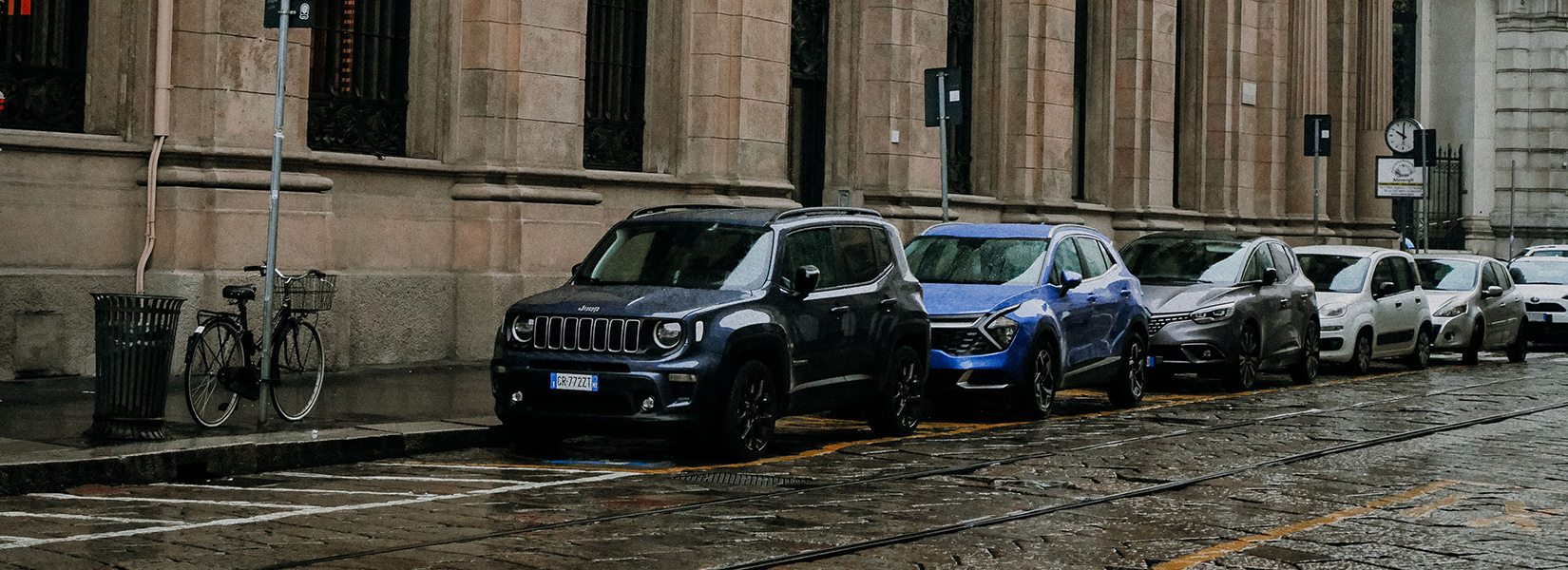
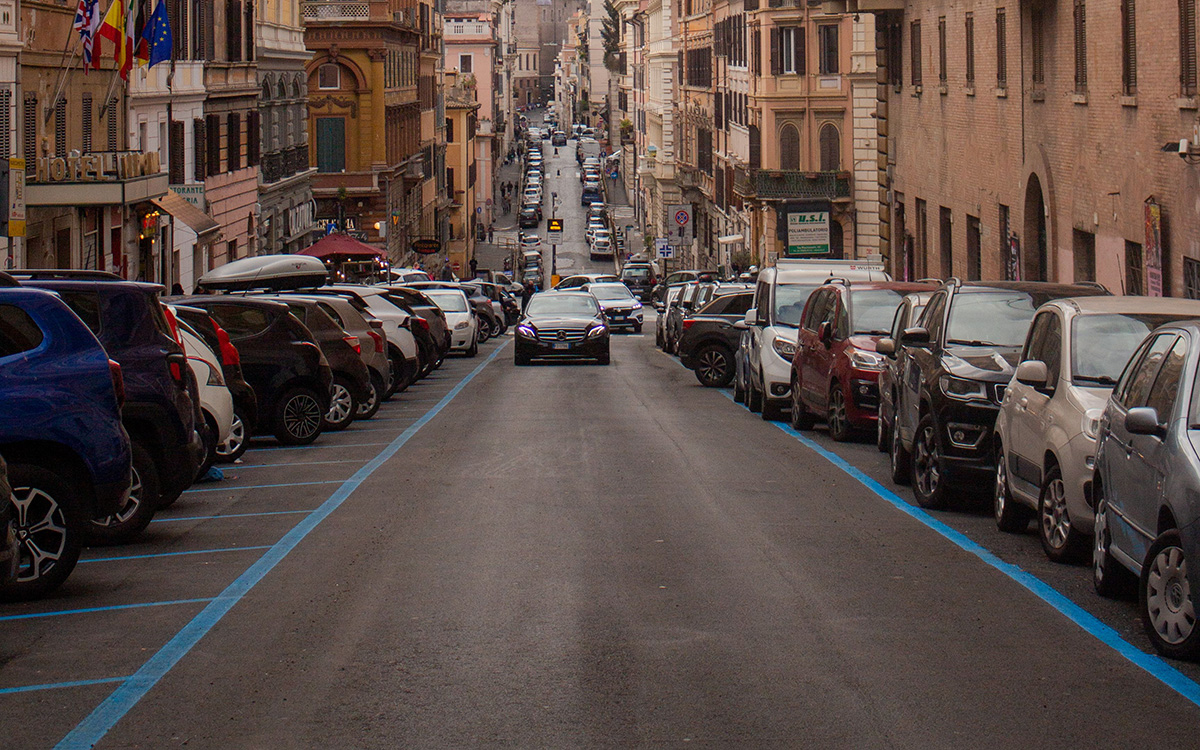
Parking space colours indicate whether parking is paid, free or reserved.
Although the system is largely consistent across Italy, always check nearby signs because local rules and time restrictions may vary.
| Blue lines | The most common paid parking spaces. Pay at a parking meter or through a parking app. |
| White lines | Usually free parking, but some spaces have time limits or require a parking disc (Disco Orario). |
| Yellow lines | Reserved for residents, disabled permit holders, emergency services, taxis or deliveries, depending on local signs. |
| Pink lines | Available only in some municipalities and usually requires a local permit. |
| Green lines | Used by a small number of municipalities for special parking schemes or environmentally friendly cars. |
Some municipalities also use additional markings or signs for electric car charging bays and loading areas.
Important. Never rely solely on the colour of the parking space. Road signs always take priority and may introduce time limits, resident permits or temporary restrictions.
How do you pay for parking in Italy?
You can pay for parking in Italy using parking meters, mobile apps or automated payment machines in parking garages.
The available payment methods depend on the municipality and the type of parking.
Parking meters and pay-and-display tickets
Parking meters are the most common way to pay for on-street parking. After payment, place the ticket clearly on your dashboard unless the parking system records your licence plate electronically.
Most parking meters accept:
- Coins
- Credit and debit cards
- Contactless payments (in many cities)
Some municipalities use licence plate recognition, meaning no paper ticket needs to be displayed.
Parking garages and private car parks
Parking garages are common in city centres, airports and railway stations. You usually receive a ticket when entering and pay before leaving using a payment machine or at the exit.
Most parking garages accept:
- Cash
- Credit and debit cards
- Contactless payments
What is the best parking app in Italy?
Parclick specialises in reserving parking garages across Italy and many other European countries.
Prices can often be compared before booking, making it easier to estimate parking costs in advance.
Parclick is particularly useful for:
- City centres
- Airports
- Railway stations
- Long-term parking
With Parclick, you can compare multiple parking garages, view prices before booking and secure your space online.
It is especially useful during the tourist season, when parking garages near major attractions often reach capacity.
Good to Know. Booking a parking garage in advance can save time and money, especially during weekends and the summer tourist season.
What are the most common parking fines in Italy?
Parking fines in Italy are commonly issued for unpaid parking, parking in prohibited areas or exceeding the permitted parking time.
Local police regularly enforce parking rules, particularly in busy cities and tourist destinations.
How much are parking fines?
Parking fines typically range from €25 to over €100, depending on the offence and the municipality.
More serious violations, such as parking in disabled spaces or blocking traffic, usually result in higher penalties.
| Violation | Typical Fine |
| Expired parking ticket | €25–45 |
| Parking in a no-parking zone | €40–90 |
| Parking on yellow reserved spaces | €80–170 |
| Blocking traffic or a driveway | €40–100+ |
| Parking in a disabled space without a permit | €165–660 |
In many municipalities, paying within five days qualifies for a reduced fine.
What should you do if you receive a parking ticket?
If you receive a parking ticket, read it carefully and check the payment deadline.
Paying within the discount period may reduce the amount of the fine, depending on the municipality.
Keep the ticket and any payment confirmation until the matter is resolved. If you rented a car, the rental company may also charge an administrative fee when processing the fine.
Foreign drivers are generally expected to pay parking fines, including those issued while driving a rental car.
How can you pay an Italian parking fine?
You can usually pay an Italian parking fine online, at a post office, through a bank or using the payment instructions printed on the ticket.
Some municipalities also allow payment by credit card through their official websites.
Always pay before the deadline to avoid additional charges. If you believe the fine was issued incorrectly, follow the appeal instructions provided by the issuing authority.
What mistakes do tourists make when parking in Italy?
The most common parking mistakes result from misunderstanding local rules rather than intentionally breaking them.
Here are the mistakes travellers make most often:
- Ignoring parking signs. Road signs always override parking space colours and may indicate resident-only parking, time limits or temporary restrictions.
- Parking inside a ZTL zone. Entering or parking in a Limited Traffic Zone in Italy without authorisation can result in a fine, even if you only drive through the area.
- Assuming white spaces are always free. White parking spaces are usually free, but some have time limits or other restrictions shown on nearby signs.
- Parking in yellow spaces. Yellow parking spaces are reserved for authorised users, such as residents, disabled permit holders or emergency services.
- Not paying for blue spaces. Blue parking spaces require payment unless signs state otherwise. Always check the parking meter or payment instructions.
- Exceeding the parking time limit. Staying longer than the paid time or permitted time limit may lead to a parking fine.
- Blocking access or traffic. Parking near driveways, intersections, pedestrian crossings or bus stops can result in fines or your car being towed.
- Leaving valuables in the car. Visible bags, electronics or other valuables can attract thieves, particularly in busy tourist areas.
Good to Know. Parking garages are often the most convenient option near historic city centres, where on-street parking is limited.
What Italian parking vocabulary should every driver know?
| Parcheggio | Parking |
| Solo autorizzati | Authorized only |
| Solo residenti | Residents only |
| Passo carrabile | Leave passage free |
| Parcometro | Parking payment machine |
| Gratuito | Free |
| A pagamento | Paid |
| Giorni feriali | Workdays (Monday – Saturday) |
| Giorni festivi | Holidays (Sundays & holidays) |
| Disco orario | Parking disc |
| Biglietto | Ticket |
| Multa | Fine |
| Strisce | Lines |
| Corsia | Lane |
What are the parking difficulties and prices in Italy’s most popular cities?
Parking difficulty and prices vary considerably across Italy.
The table below compares the most popular cities to help you understand where parking is easiest, where it is most challenging and what costs you can generally expect.
| City | Parking difficulty | Parking prices |
|---|---|---|
| Rome | ★★★★★ | ★★★★ |
| Milan | ★★★★ | ★★★★★ |
| Florence | ★★★★★ | ★★★★ |
| Venice | ★★★★★ | ★★★★★ |
| Bologna | ★★★★ | ★★★★ |
| Turin | ★★★ | ★★★ |
| Naples | ★★★★ | ★★★ |
| Pisa | ★★★ | ★★ |
| Bari | ★★★ | ★★ |
| Palermo | ★★★★ | ★★ |
| Catania | ★★★ | ★★ |
- Parking in Rome. Parking is among the most challenging in Italy, especially near the historic centre and major attractions. A parking garage outside the ZTL zone is usually the most convenient option.
- Parking in Milan. Finding parking is generally easier than in Rome, although the city centre can still be busy. Parking garages and Park & Ride facilities are often the best choice.
- Parking in Florence. Parking is difficult because much of the historic centre is covered by a ZTL zone. Most visitors use parking garages outside the restricted area.
- Parking in Venice. Cars cannot enter the historic islands, so visitors usually park at Tronchetto or Piazzale Roma. From there, continue by water bus or on foot.
- Parking in Bologna. Parking is generally manageable, although spaces near the historic centre are limited. Parking garages provide convenient access to the main attractions.
- Parking in Turin. Parking is relatively easy compared with many other large Italian cities. Both street parking and parking garages are widely available.
- Parking in Naples. Parking can be challenging due to heavy traffic and limited availability. Secure parking garages are usually the most practical option.
- Parking in Pisa. Parking is relatively straightforward, with several public parking areas within walking distance of the city centre. Parking garages are also available for longer visits.
- Parking in Bari. Parking is generally easy, although spaces near the Old Town fill quickly during busy periods. Parking garages offer a convenient alternative.
- Parking in Palermo. Parking can be busy around the historic centre and popular attractions. Many visitors choose secure parking garages to save time.
- Parking in Catania. Parking is generally easier than in Palermo or Naples, although central streets become busy during the day. Paid street parking and parking garages are widely available.
Plan your trip to Italy
FAQs
No, unless you have authorisation. Most ZTL zones are restricted to residents, permit holders or authorised vehicles, and entering without permission can result in a fine.
A Disco Orario is a parking disc that shows your arrival time. It is used in some free parking areas with time limits and must be displayed on your dashboard where required.
It depends. Many supermarkets offer free customer parking, although some have time limits or require you to validate your parking while shopping.
It depends. Some municipalities offer free parking on Sundays or public holidays, while others continue to charge, so always check the local parking signs.
Yes. Blue parking spaces are generally available to everyone, provided you pay the required parking fee and follow any local restrictions.
Yes, in most legal parking spaces. Always check nearby signs, as some areas have overnight restrictions, street cleaning schedules or resident-only parking during certain hours.
The rental company will usually identify you as the driver and charge an administrative fee. You remain responsible for paying the parking fine issued by the local authority.
No, it is best to avoid leaving luggage or valuables visible inside your car. In busy tourist areas, visible belongings may increase the risk of theft.
Always check the parking signs, not just the parking space colours. Parking a little outside the city centre, using parking garages and reserving a space in advance can make parking easier and help you avoid fines.